


Wheel Alignment Near Manorville
Schedule a Wheel Alignment Near Me
You should get a wheel alignment every 12,000 to 15,000 miles, whenever you purchase new tires, after hitting a severe pothole or curb, or immediately if your vehicle pulls to one side or has an off-center steering wheel. Following manufacturer Maintenance Minder guidance and inspecting alignment after suspension repairs ensures proper handling and maximum tire life.
Maintaining proper chassis geometry is critical for passenger safety, steering responsiveness, and tread longevity. Vehicle suspension systems contain multiple adjustable connection points that can shift over time due to routine vibration, aging rubber bushings, or sudden road impacts. When these components move outside factory tolerances, your tires no longer contact the pavement at the precise angle designed by engineers.
During a complete chassis inspection, certified automotive technicians measure three primary angles:
- Camber: The inward or outward tilt of the tire when viewed directly from the front of the vehicle. Incorrect camber causes accelerated wear on the inner or outer edge of the tread.
- Caster: The forward or backward slope of the steering axis when viewed from the side. Proper caster balances steering stability at highway speeds and aids automatic wheel centering after making a turn.
- Toe: The degree to which the front or rear tires turn inward or outward relative to each other when viewed from directly above. Improper toe settings create severe scrubbing across the tread face, dramatically shortening tire lifespan.
For local suburban drivers navigating the rural back roads and changing pavement conditions around Manorville, annual chassis checks prevent minor alignment shifts from turning into costly tire replacements. While vehicle manufacturers do not specify a single rigid interval for every driving condition, incorporating an alignment check alongside routine tire rotations ensures early detection. To schedule an inspection or speak with our service team directly, give us a quick call at (631) 727-0555 or stop by our service center location on County Road 58.
What Are the Main Symptoms That Your Car Needs an Alignment?
The most common indicators that a vehicle requires an alignment are a noticeable drift or pull to one side while driving on a level road, an off-center steering wheel when traveling straight, uneven or rapid tire tread wear, and steering wheel vibrations. Addressing these early warning signs prevents compound damage to your steering gear and suspension linkage.
Recognizing alignment symptoms before severe tire degradation occurs saves vehicle owners substantial money over time. When steering geometry shifts out of specification, the vehicle communicates the misalignment through specific physical behaviors:
- Vehicle Drift or Pull: If your vehicle consistently veers toward the shoulder or center line when you briefly loosen your grip on the wheel on a flat, straight road, the wheel angles are out of alignment.
- Off-Center Steering Wheel: When driving straight down a clear highway, your steering wheel emblem should rest perfectly level. A crooked steering wheel indicates that the front or rear toe angles are misaligned relative to the steering column.
- Uneven Tread Wear: Examining tire tread patterns reveals critical diagnostic details. Feathering—where tread blocks feel smooth when wiped in one direction but sharp in the opposite direction—points directly to incorrect toe settings. Heel-and-toe wear or heavy shoulder wear indicates camber misalignment or worn ball joints.
- Steering Wheel Vibration: While wheel unbalance usually causes high-speed vibration, misaligned tires scrubbing against the road surface can also create subtle oscillation through the steering column.
Driving over deep frost-heaves or hitting unexpected potholes can instantly bend control arms, loosen tie-rod ends, or shift strut mounts. If inspection reveals worn tie rods or damaged control arm bushings that prevent your vehicle from holding spec, our team stocks genuine OEM suspension components engineered precisely for your exact vehicle configuration.
Find Honda Specials on Wheel Alignment
Which Vehicles Require a Four-Wheel Alignment vs Front-End Alignment?
Four-wheel alignments are required for all-wheel drive, four-wheel drive, and front-wheel drive vehicles equipped with independent or adjustable rear suspensions, whereas front-end alignments only adjust vehicles built with a solid, non-adjustable rear axle. Modern crossovers, SUVs, sedans, and hatchbacks feature multi-link or double wishbone rear suspension systems that require precise four-wheel adjustment.
Understanding the mechanical distinction between alignment types helps drivers select the correct service for their specific model:
Four-Wheel Alignment
A four-wheel alignment measures and adjusts the geometry on all four wheels relative to the geometric centerline of the chassis. Technicians calibrate the camber, toe, and tracking angles on both the front and rear axles. Vehicles requiring this comprehensive service include:
- All-wheel drive (AWD) and four-wheel drive (4WD) SUVs and crossovers (such as the Honda CR-V, Pilot, and Passport).
- Front-wheel drive sedans and hatchbacks built with independent rear suspension systems (such as the Honda Civic and Accord).
- Vehicles equipped with advanced safety technologies that rely on calibrated steering angle sensors.
A primary metric during a four-wheel alignment is adjusting the thrust angle. This angle defines the exact direction the rear wheels point relative to the vehicle centerline. If the thrust angle is out of alignment, the rear tires push the vehicle sideways, causing the driver to compensate by holding the steering wheel crooked—a condition known as “dog-tracking.”
Front-End Alignment
Also known as a two-wheel alignment, a front-end alignment measures and adjusts only the front steering axle ( camber, caster, and toe). The technician verifies that the front wheels are aligned relative to the fixed rear axle. Front-end alignments are limited to older vehicles or specialized commercial trucks built with a rigid rear axle beam or solid rear drive axle that lacks factory adjustment points.
Contact Our Honda Service Center Near Manorville
Should Tire Balancing and Wheel Alignment Be Done Together?
Performing tire balancing and wheel alignment together is strongly recommended during routine tire maintenance because they address two entirely separate mechanical conditions: balancing corrects uneven weight distribution around the wheel assembly, while alignment corrects the mechanical angles at which the tires touch the road. Combining these services guarantees optimal ride comfort, predictable vehicle handling, and maximum tread durability.
While both services protect your tire investment, they resolve distinct issues:
- Wheel Alignment: Adjusts the angles of the suspension linkages so the tires align with each other and the road surface. Alignment prevents scrubbing, sideways dragging, and uneven shoulder wear.
- Tire Balancing: Places small counterweights on the wheel rim to compensate for subtle heavy spots in the tire rubber or wheel casting. Balancing eliminates high-speed wheel bounce and steering wheel shimmy.
When purchasing a new set of tires or performing seasonal tire rotations, pairing alignment with wheel balancing ensures complete protection. For instance, on standard passenger car tire rotations, mounting wheels correctly requires securing fasteners to the proper torque specification—such as the factory specified wheel-nut torque of 80 lbf·ft ( 108 N·m) found on models like the Honda HR-V. Combining these maintenance steps extends tire tread life by tens of thousands of miles. To protect your tires with factory-standard chassis care, you can schedule a wheel alignment service online at your convenience.
How Long Does a Wheel Alignment Service Usually Take?
A standard wheel alignment service usually takes between 30 and 60 minutes to complete under normal conditions. The required time can extend to 90 minutes or more if suspension hardware requires rust penetration, if component adjustments are seized, or if integrated driver-assist safety systems require digital recalibration.
The standard alignment procedure involves a systematic, multi-step process carried out on a specialized alignment rack:
- Initial Inspection (10–15 Minutes): Technicians inspect tire pressure, tread depth, ball joints, tie rods, control arm bushings, and wheel bearings to confirm that suspension linkages are free of structural looseness.
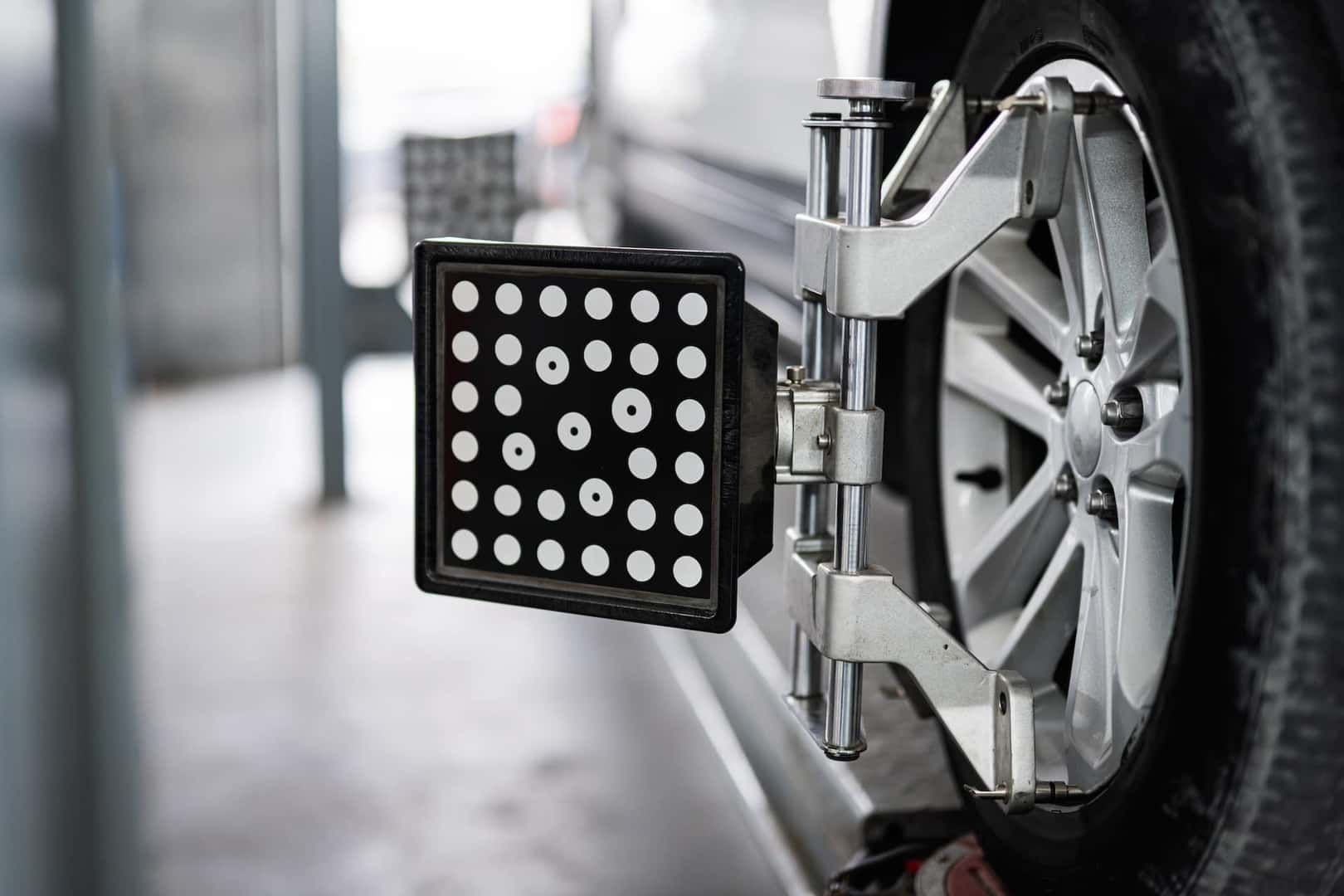
- Sensor Setup & Baseline Measurement (10 Minutes): High-definition optical targets or digital sensors attach to all four wheels. The computerized alignment machine scans the exact layout to compare current camber, caster, and toe against factory engineering parameters.
- Mechanical Adjustments (20–30 Minutes): Using precision hand tools, technicians loosen locknuts and turn eccentric bolts or tie-rod sleeves to restore wheel angles to exact factory specifications.
- Advanced Driver-Assist Recalibration (15–30 Minutes, if equipped): Modern vehicles equipped with lane-keeping assist, adaptive cruise control, or collision mitigation systems require steering angle sensor resets so computer safety features read straight-line travel accurately.
- Final Road Test (5–10 Minutes): The vehicle is road-tested on local roads to verify straight-line tracking, level steering wheel position, and smooth handling return.
Where to Get Certified Wheel Alignment Service Near Manorville
Drivers seeking factory-certified wheel alignment near Manorville can access complete computerized alignment services at Apple Honda, located directly at 1375 County Rd, 58, Riverhead, NY 11901. Our modern service center features specialized alignment racks designed to restore original handling precision across all vehicle makes and models.
Living and commuting in the rural countryside surrounding Manorville exposes vehicles to unique road challenges. Daily travel past agricultural farms, Pine Barrens nature areas, and unpaved access points subjects tires to gravel, sand, and severe potholes. Over time, these daily driving conditions knock suspension components out of alignment.
Choosing factory-certified service provides clear ownership advantages:
- Factory-trained technicians who understand exact model geometry and multi-link suspension specs.
- Advanced computerized alignment technology with real-time laser measurement accuracy.
- Complete diagnostic integration to reset steering angle sensors and recalibrate safety camera modules.
- Genuine OEM replacement parts for any worn control arms, tie rods, or sway bar links.
Book a Honda Wheel Alignment Near Me
Frequently Asked Questions About Wheel Alignment Service Near Manorville
Q: How do I know if my steering wheel off-center condition is alignment or tire pressure?
Checking tire pressure is the first step when diagnosing steering pull. Measure cold inflation levels across all four tires; uneven tire pressure can cause a vehicle to drift toward the under-inflated side. If all tires are properly inflated to recommended door-jamb specifications but the steering wheel remains crooked while traveling straight, the suspension alignment angles are out of spec and require mechanical adjustment.
Q: Can misaligned wheels lower vehicle fuel economy?
Yes, misaligned wheels noticeably reduce overall fuel economy. When tires point at improper angles, they scrub sideways against the road surface rather than rolling smoothly. This creates continuous rolling resistance, forcing your engine or electric motor to consume extra energy to maintain highway speeds. Correcting chassis alignment restores optimal fuel efficiency and reduces tire friction.
Q: What happens if I ignore signs of poor wheel alignment?
Ignoring poor alignment causes severe, irreversible tire wear, forcing complete tire replacement thousands of miles early. Beyond destroying tread, uncorrected alignment places uneven mechanical stress on wheel bearings, ball joints, tie rods, and shock absorbers. Over time, this accelerates component fatigue, leading to higher repair costs and degraded vehicle handling safety.
Q: Do new tires automatically come aligned when installed?
No, mounting and balancing new tires does not adjust vehicle suspension angles. Mounting attaches the tire to the wheel rim, while alignment calibrates the steering and suspension arms under the vehicle. Scheduling a four-wheel alignment alongside new tire installation guarantees that fresh tread wears evenly from the day it is installed.
Q: Does Honda Roadside Assistance help with alignment issues on the road?
If a severe pothole or road hazard impact damages your suspension or causes a tire blowout, Honda Roadside Assistance: 1-800-594-7454 provides emergency towing to an authorized service facility for safety evaluation. Our service team will inspect your wheels, tires, and suspension linkages for hidden impact damage. For directions or scheduling assistance, visit our Riverhead facility or call (631) 727-0555 today.